Beyond the numbers: Mastering Nice Côte d'Azur Airport (LFMN)


The French Riviera airport, Nice Côte d'Azur, has clear weather more days than not. The runways are long, and the surrounding scenery is hard to argue with. Crews who fly here regularly will tell you that it catches people off guard because it looks easy.
But flying into LFMN is anything but easy. Between mandatory visual approaches, strict noise-abatement rules that can carry hefty fines, and air traffic control often requesting tailwind landings, there’s a lot to manage. Throw in the chaos of peak event season and the region’s unpredictable coastal weather, and this airport will test even experienced operators.
This is the next blog in our Beyond the Numbers series, where we’re diving into the challenges of operating at LFMN and highlighting the environmental, procedural, and logistical hurdles your operation should plan for.
The field at a glance
Nice, France, is a coastal town between the Mediterranean and the Alps. The airport sits on a narrow strip of land along the coastline, just over 3 miles southwest of the city center. The surrounding mountains are close, and they play a big part in the development of arrival and departure procedures.
To the west, the Var River valley cuts through the terrain and often causes windshear on final approach to Runway 04L/R. To the north and east, Alpine ridgelines generate significant turbulence that reaches the threshold on particularly windy days.
The airport itself is well-equipped with two parallel runways, each over 8,500 feet long, a dedicated General Aviation Terminal, 24-hour operations, and official Airport of Entry Status. It simultaneously handles scheduled airline traffic, business jets, helicopters, and VFR traffic.
During major events like the Monaco Grand Prix or the Cannes Film Festival, it handles all of that at once, at capacity, with near-zero available parking. The infrastructure isn’t typically the challenge for business aviation operators. It’s the geography, the procedures, and the environment.
What makes Nice Côte d'Azur challenging
Terrain-driven procedures and visual approach
Runway 22L/R. Mandatory visual, no approach lights, over water. The terrain north and east of LFMN means a conventional instrument approach is not possible. There is no ILS, no approach lights, and the deep water combined with maritime traffic along the coast make installing them impractical. What you get instead is an RNP procedure that transitions to a fully visual segment starting at 4.5 nautical miles from the runway, followed by an 80-degree turn at low altitude over water to align with the runway.
If your aircraft lacks RNP capability, the VOR procedure is your only option, and it’s more demanding. It also ends in a lengthy visual segment, but this one begins 5 nautical miles out and requires two turns at low altitude over water instead of one.
.png)
Either way, you’re flying over the Mediterranean with no external lighting references below, terrain rising behind, and an offset PAPI due to terrain constraints.
At night, things get trickier. The infamous “black hole effect” means you can’t judge your height or speed easily, since there’s nothing but water underneath. Meanwhile, the city lights behind the runway can make it almost impossible to pick out the runway against the background. You need to know exactly what you’re looking for when you roll out of that 80-degree turn.
Go-arounds are not simple either. The procedure requires a low-altitude level-off followed by a rapid turn back toward the sea because terrain inland rises quickly, leaving you with no safe straight-ahead option.
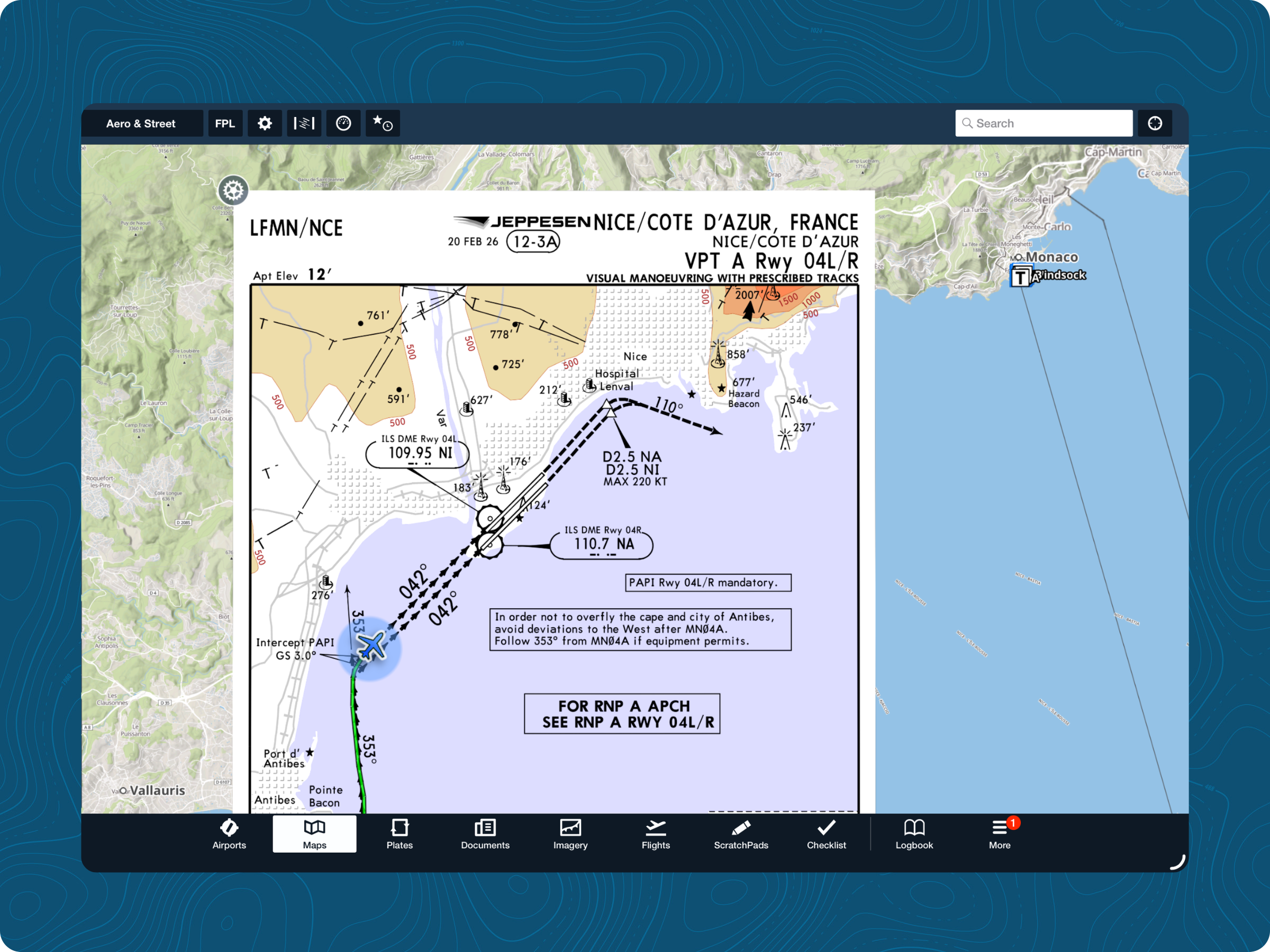
Runways 04L/R. The noise abatement trap. Runway 04L/R offers an ILS, but in most conditions, flying it will cost you, literally. The preferred procedure for noise abatement is an RNP or VOR-DME indirect approach with a 45-degree visual turn to final. If you fly a direct approach when the indirect route is in service, you may be subject to an investigation by ACNUSA, the French Airport Noise Nuisance Control Authority, and result in fines of up to €40,000.
The indirect approach isn’t difficult for a prepared crew, but it does require a visual turn to final to parallel runways that look identical from the air. Like Runway 22, there are no approach lights. The missed approach and departure procedures require very early turns toward the sea due to close terrain on the northeast side of the airport.
Wind and weather
Visibility is another factor that makes landing challenging. Southerly winds often bring sea haze, reducing contrast and depth perception on approach. That’s on top of the already challenging visual approach over the water. Bird activity is a year-round hazard, with spring and autumn seeing the highest concentration along the coastal approach paths.
None of these factors is necessarily disqualifying on its own. The issue is that they tend to stack. If you’re managing a visual approach in hazy conditions, with a shifting sea breeze and turbulence near the threshold, you’re handling several things at once in an environment that offers little margin for error.
Air Traffic Control complexities
During peak traffic periods, ATC regularly assigns tailwind operations beyond standard ICAO recommendations to manage flow between runway configurations. According to IFALPA, tailwinds exceeding the 5-knot ICAO recommendation are routinely used to avoid frequent configuration changes and to prioritize Runways 04L/R. ATIS notifications for configuration changes are frequently delayed, so it’s not uncommon that the arrival you brief is not the one you fly.
Once near the airport, the proximity of Monaco and Cannes generates consistent helicopter and VFR traffic that may not always be on TCAS. ATC regularly holds arriving business jets at high altitudes during peak periods, forcing high descent profiles that reduce the time available to configure, stabilize, and brief your approach.
On the ground, the airport’s inverted use of runway pairs, where crossing occurs before takeoff rather than after landing, creates runway incursion risks. Several taxiways lack stop bars, which means your situational awareness needs to match what you had during the arrival.
Airport Collaborative Decision Making (A-CDM)
Nice launched A-CDM in 2019, and you can face consequences when your schedules change at the last minute. Under A-CDM, every movement at LFMN is synchronized with the airport’s slot allocation platform. If your filed flight plan doesn’t match the confirmed slot, the system flags it and auto-cancels it. Both your airport slot and airway slot can be lost simultaneously due to a minor schedule change.
If you have certain passengers that are prone to changing departure times or adding stops on the day of travel, it’s a good idea to have a Plan B just in case. Having a contingency plan in place can make all the difference when schedules change unexpectedly.
What the accident record tells us
In September 2025, a runway incursion occurred on Runway 04R when a Nouvelair A320 on final approach from Tunis flew directly over an easyJet A320, at an altitude of only 3 meters, aligned on the runway for takeoff. The easyJet crew aborted the takeoff, and the Nouvelair aircraft was diverted to Runway 04L, where they landed safely.
The preliminary findings point directly to what we’ve discussed. Close-spaced parallel runways, a visual approach that requires precise situational awareness, and confusion between 04L and 04R when crews manually navigate after vectors or visual clearances. Rain and reduced visibility were present at the time of the incident.
A critical factor in this incident was the visual identification of the correct runway at night. The two runways have different lighting systems and brightness levels, and with a spacing of only 300 meters, it is easy to misidentify your target during a visual descent.
Neither flight involved business aviation, but the runway on which the near miss happened is the same one every operator uses at LFMN. The parallel runway spacing is tight, the visual approach is mentally demanding, and the ground movement is complex. None of that changes based on aircraft type. What changes is the level of preparation the crew brings to it.
Best practices for Nice Côte d'Azur operations
Train for Nice before you fly there
IFALPA explicitly recommends simulator training before your first visit to LFMN. Operators who consistently and safely operate here prepare for this airport before they need to. IFALPA also recommends against using Nice as an alternative airport for the exact reasons we’ve discussed. It’s not a place to figure out on the fly.
Calculate missed approach climb performance before you descend
The go-around off Runways 22L/R is a terrain-avoidance maneuver, not a standard missed approach. Knowing before your descent begins whether your aircraft can meet the climb requirements at actual landing weight changes your decision-making process.
Prepare for the busy season
The Monaco Grand Prix, the Cannes Film Festival, and the major regattas and galas around the French Riviera are among the biggest reasons business aviation operators fly to Nice. Your clients want to be there on the busiest days, which are the same days parking is spoken for, PPR confirmations are delayed, APU restrictions are enforced, and fuel coordination requires advanced arrangement.
Beyond just parking, is EU Regulation 2015/1998, outlining that Aircraft Security Search forms must be collected upon arrival. Furthermore, your crew ID cards must explicitly say “CREW” rather than just “PILOT,” as local authorities have recently become more stringent on this distinction.
Mastering LFMN and beyond
The French Riviera is one of the busiest business aviation destinations in Europe, and it isn’t slowing down. The number of major events will continue to grow, and client expectations will continue to increase. LFMN will remain your gateway to it all.
ForeFlight Runway Analysis provides you and your planners with performance calculations tied to real-time conditions, including current temperature, pressure altitude, wind components, and aircraft weight.
Operators who consistently fly into Nice safely aren’t necessarily more capable than others. They are just more prepared. They train the approaches before flying them, and they’re working from performance data in the cockpit that dispatch built the flight around.
Visit our website to learn more about ForeFlight Runway Analysis.