How smart operators stay ahead of rising fuel prices


Fuel is the single largest direct operating cost in aviation, making up anywhere from 30 to 50 percent of hourly operating expenses, depending on aircraft type. Operators have always known this. What’s harder to manage is when the market moves fast, and the tools you’re using don’t keep up.
The fuel prices you see on the ramp are a direct result of geopolitical conflict, refinery disruptions, fluctuating crude markets, and shifting trade policies. It’s not uncommon to see fuel costs swing up to 30 to 40 percent in just a few days, and history shows that when pressure builds, prices at the pump soon follow.
The operators who weather these ups and downs best are those with the clearest visibility into fuel pricing, not necessarily the ones with the largest budgets. Smart decisions about where to fuel, how much to carry, and when to tanker depend on current data, integrated workflows, and a true picture of your trip’s total cost.
The cost of “good enough” fuel planning
For many operators, fuel planning still looks something like this: check in at an FBO, use a price that might be a few days old, load what feels right, and move on.
The weight penalty myth
It’s easy to assume that fueling up at the home base is always the cheapest, but that’s not always true. When you factor in price gaps between airports, ramp fees, and the actual cost of carrying extra weight, things get complicated. Every extra ton of fuel carried burns roughly 30 kg per hour just to transport it. On a two-hour leg, that’s fuel burned just to carry fuel you may not need.
When data is stale or contract rates aren’t visible, tankering decisions are often made out of habit instead of hard data.
The complexity behind fuel decisions
Pricing is just one variable
Real-time pricing, contract rates, and volume discounts might all be available at one airport, but if you’re looking in the wrong place, you could miss it. You might pay retail when a contract rate was right there, or miss a minimum uplift that would have waived handling fees.
Variables change constantly
Everything changes fast: fuel prices, aircraft weight, routing, and weather can all shift between planning and departure. Figuring out the best fuel load for every flight should be something that can be done at the press of a button; it isn’t realistic to do it by hand every flight
The shift towards data-driven fuel optimization
Data-driven fuel planning is less about replacing experienced crews or dispatchers and more about giving them better inputs so their decisions are faster, more consistent, and based on current information.
Rather than defaulting to old routines, data-driven tools let you model different scenarios before you lock in a plan. For example, should you tanker fuel from home, buy on arrival, or split fuel across multiple legs? Integrated tools model these scenarios to calculate the most fuel-efficient approach for each flight, rather than sticking to a one-size-fits-all plan.
The right question isn’t “where is fuel cheapest?” It’s “what is the smartest fueling strategy for this specific trip, today, given these conditions?”
Find your competitive advantage in fuel planning
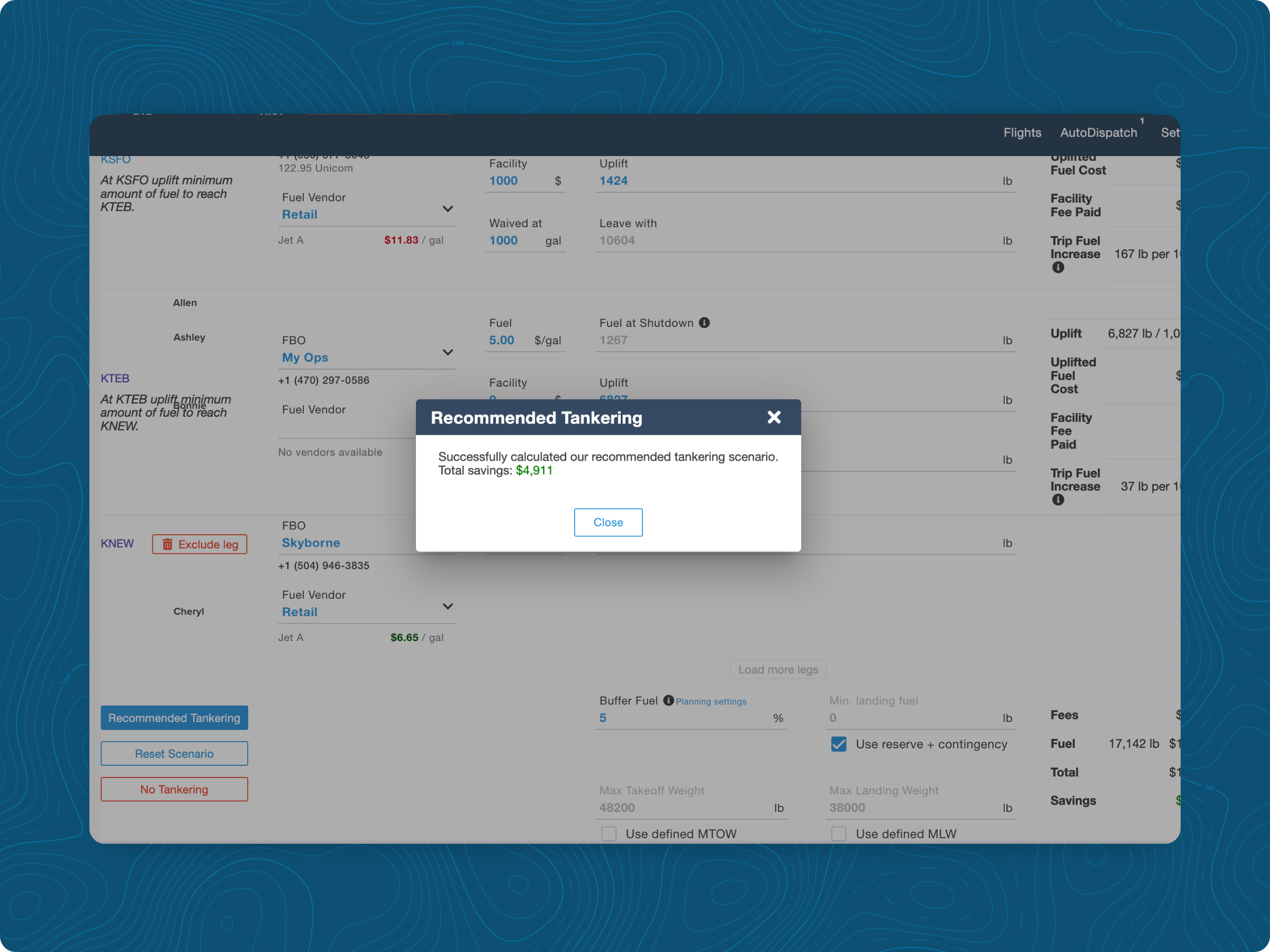
In a volatile market, your competitive advantage comes from planning smarter, not just flying more efficiently. ForeFlight Fuel Advisor brings all your fuel-saving options into one dashboard, showing tankering recommendations and the reasoning behind each.
One of the most underused advantages for turbine operators is contract fuel pricing. Too often, it goes unused simply because the rates aren’t visible. JetFuelX, available on all subscription levels, changes that by letting you link contract fuel accounts directly to ForeFlight, so you can see contract prices across the U.S., Canada, Europe, and Central America right in your planning workflow.
Planning beyond the next leg
Fuel Advisor analyzes multiple planned legs simultaneously to optimize fueling decisions across the entire trip. That kind of big-picture visibility is what separates an optimized strategy from a series of one-off decisions.
Small decisions, big savings
Saving a few hundred dollars per leg might not seem huge, but after 300 flights per year, it adds up to hundreds of thousands in avoided costs. All it takes is making better decisions with the right tools.
The best operators make good decisions on every leg and route. Data lets you spot trends, compare routes, and see where you can do better.
Smarter decisions start with better visibility
You can’t control fuel prices, but you can control how you respond to them.
Operators who consistently save on fuel all have one thing in common: they work from better information, earlier in their planning. They see contract rates alongside retail and make calculated tankering decisions.
ForeFlight Fuel Advisor and JetFuelX bring that visibility directly into the planning workflow, so every leg benefits from the same analysis that today is applied only by the most disciplined operations.
To start making smarter decisions about fuel planning, visit ba.foreflight.com